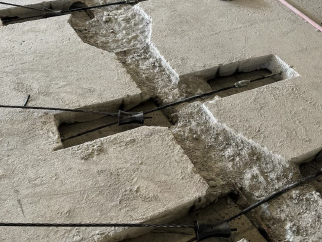
Post-tensioned (PT) concrete systems are ubiquitous in modern UAE construction, enabling thin, long-span floor slabs in high-rise towers, multi-story car parks, transfer decks, and viaducts. However, when PT tendons suffer accidental cutting during core drilling, anchorage zone spalling, water ingress through end blockouts, or severe tendon corrosion, the structural stability of the entire floor plate is compromised.
F L X Building Contracting LLC is one of the specialized contractors in the UAE equipped with the engineering competence, certified PT technicians, and specialized hydraulic equipment required to safely repair post-tensioned systems without precipitating sudden structural failure.
Our systematic approach integrates high-frequency Ground Penetrating Radar (GPR) tendon mapping, calibrated de-tensioning, specialized strand coupler splicing, hydraulic re-stressing to exact design elongation, and vacuum pressure void regrouting.
Precision mechanical strand splicing using certified center-pull coupler barrels and high-tensile 1860 MPa low-relaxation steel strands.
Rebuilding blown or crushed anchorage pockets, reinforcing bursting and spalling zones with specialized spirally tied rebar cages and micro-concrete.
High-vacuum evacuation of unbonded or partially grouted internal tendon ducts followed by pressure injection of non-bleed thixotropic cementitious grout.
Complete excavation of contaminated mortar from anchor blockouts, sandblasting wedge grips, and hermetically sealing with elastomeric epoxy systems.
Engineering supplemental external Carbon Fiber (CFRP) laminates on the tension face of slabs where tendon damage cannot be re-stressed internally.
Deep subsurface Ground Penetrating Radar (GPR) imaging to map exact 3D tendon drape profiles, conduit depths, and unbonded anchor locations before coring.
Detailed high-frequency electromagnetic radar scanning mapping live tendon profiles, duct condition, cover depths, and identifying broken or detensioned strands.
Vibration-free hydro-demolition or delicate chiseling to expose damaged strand sections without damaging adjacent high-stress unbonded mono-strands.
Installing specialized post-tension strand couplers and positioning calibrated monostrand hydraulic stressing jacks with digital pressure transducers.
Stressing strands in incremental stages while recording elongation measurements and verifying load transfer according to original structural design sheets.
Grouting duct voids with zero-bleed cementitious grout and sealing the repair pocket with high-strength non-shrink micro-concrete and epoxy waterproofing caps.
Direct engineering answers regarding UAE municipal compliance, testing standards, and site execution.
Submit technical parameters for rapid estimation and site inspection.